
The ocean does not always cooperate. Flat spells last for weeks. Work schedules do not respect swell windows. Off-season stretches on. And when you finally paddle back out after a gap, the difference between a surfer who has been training and one who has not is obvious within the first few waves.
Surf training at home cannot replace time in the water. Nothing can. But the right land training keeps the muscle memory alive, sharpens the balance pathways in your nervous system, and prepares your body to perform when the conditions finally deliver. Indo Board has been the tool serious surfers use for this since 1998.
Here is how to make it work.
Why On-Land Balance Training Transfers to Surfing
Your brain does not fully distinguish between the balance challenge of standing on an unstable balance board over a roller and the balance challenge of riding a wave. The neurological pathways being trained are the same ones you use in the water.
Proprioception, your body's real-time awareness of its own position, is the core skill in surfing. When you shift your weight to drive a bottom turn, you are not consciously calculating the physics. Your body has learned what to do through repetition. Balance board training is repetition. It builds and reinforces those movement patterns in a controlled environment, so they are sharper and more automatic when you need them.
Surfers who train consistently on Indo Board report better paddle timing, cleaner pop-ups, faster edge adjustments, and improved recovery when they get caught off-balance on a wave. The transfer is real. It is also cumulative -- the more consistent the training, the more pronounced the improvement.
The Indo Board Setup for Surf Training
Two setups work especially well for surf-specific training.
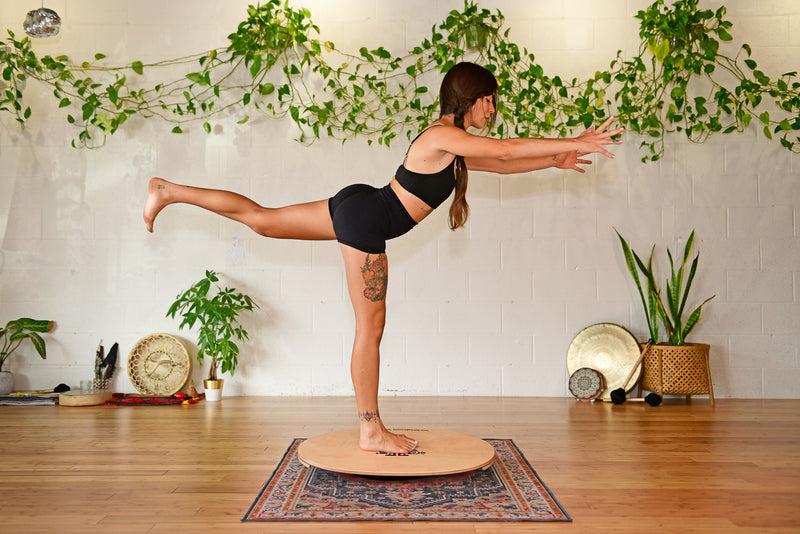
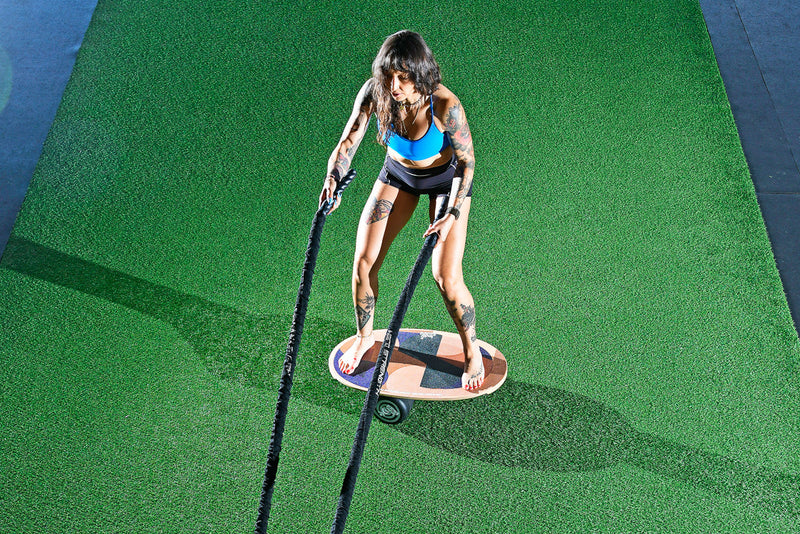
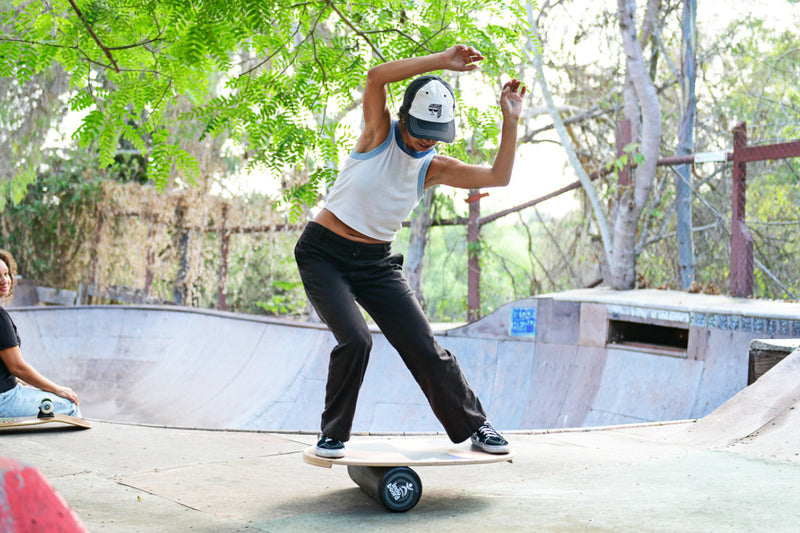
The Original Board with roller is the starting point for most surfers. The cylindrical roller creates a dynamic instability that closely mimics the lateral movement of a surfboard on water. You control the roll with your weight distribution, same as in surfing. This is where you build the foundation. [Indo Board Original]
The Indo FLO Cushion introduces a different kind of instability. Instead of a rolling cylinder, the cushion creates multi-directional movement that demands more from your ankle stabilizers and hip control. Advanced surfers use it to add a higher level of challenge and to simulate the softer, less predictable feel of mushy or chopped-up surf. [Indo FLO Cushion]
Start with the roller setup. Once you can hold a stable position for 60 seconds without touching the edges, begin introducing the surf-specific exercises below. Progress to the FLO cushion when those feel controlled.
5 Surf-Specific Indo Board Exercises
1. The Pop-Up Hold
Stand in your surf stance, front foot angled, back foot perpendicular, weight centered over the board's midpoint. Hold that position while the roller moves beneath you. Focus on keeping your knees soft and your hips low. This is the static version of the pop-up position. Target: 3 sets of 30 seconds. When it feels easy, close your eyes.
2. The Nose Ride
Shift your weight progressively toward the front of the board, driving the nose down until it touches the ground, then recover to center. This trains the forward weight distribution you need for trim speed and noseriding. It is harder than it sounds. Target: 3 sets of 10 controlled nose-taps.
3. The Cross-Step
From your surf stance, step your back foot to center, then front foot forward toward the nose -- a single cross-step while maintaining balance. Recover to your starting position. This trains the footwork for longboard cross-stepping and the coordinated weight transfer that shortboarding demands in turns. Target: 2 sets of 8 steps each direction.
4. The Tail Drop
Shift your weight progressively toward the tail of the board, letting the tail sink toward the ground, then recover to center with control. This trains the muscle memory for pulling back into a turn, stalling for a tube, or repositioning on the back foot. Target: 3 sets of 10 controlled tail-drops.
5. The Quick-Recovery Drill
Intentionally move the board to an off-balance position -- near the edge of the roller's range -- then recover to center as quickly as you can. This trains the reactive balance that kicks in when a wave section surprises you or a wipeout recovery demands fast stabilization. Target: 3 sets of 15 recovery reps.
How Often to Train
Fifteen to twenty minutes a day is a genuinely effective session. You do not need an hour. The neurological adaptation that balance board training produces responds to frequency -- five short sessions per week will do more for your surfing than one long session on the weekend.
The best time to train is whenever it fits your actual schedule. Morning before work, during a break, after the kids are in bed. The board does not care. It fits in a living room, a garage, or an office. The only requirement is that you get on it.
What Progression Looks Like
In the first week, expect to feel unstable and to touch the edges of the roller range frequently. That is normal. Your nervous system is learning.
By week two, most people can hold a basic stance for 30 to 60 seconds and start to feel the board respond to intentional weight shifts rather than just reacting to it.
By week four, the exercises above start to feel controlled. You will notice the difference in the water, your pop-ups feel quicker, your weight distribution on a wave feels more deliberate, and your recovery when you get off-balance is faster.
By week eight, most surfers describe the board as feeling like an extension of their training routine rather than a challenge. That is when you add the FLOW cushion, try the exercises with eyes closed, or work on the trick progressions that Indo Board riders have been building for 25 years.
Get started with the Indo Board Original -- the setup used by surfers from Hossegor to Huntington Beach for nearly 30 years. Shop Indo Board Original